Basics
Understanding democracy is a system-level challenge – not just districts, but all the practices and procedures that go into electing representatives. Here, you’ll find clear, accessible explanations behind some of the key topics we work on. Whether you’re a student, journalist, community advocate, or a curious citizen, these guides break down complex ideas into digestible concepts.
-
-
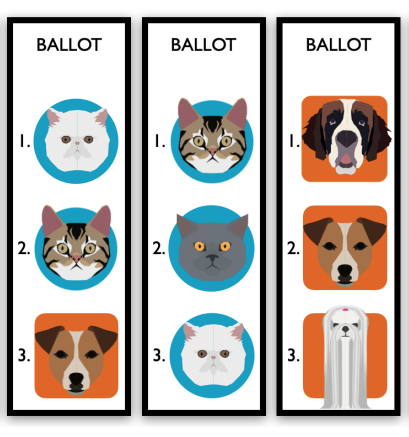
What is ranked choice voting? In popular culture, it is an umbrella term for any election method that asks voters to provide their preferences about the candidates and converts those preferences to a set of winners. Many different election methods can be classified as ranked choice, including plurality!
Read more about ranked choice voting in this explainer by Thomas Weighill and Moon Duchin from the book, “Political Geometry.”
-

-
Redistricting and gerrymandering: Redistricting is the process of drawing new legislative boundaries, usually in order to balance the population across districts. Map makers have a lot of latitude, and how they draw the lines can impact the outcome of the elections. When they draw lines to benefit one group over another, we call this gerrymandering.
Our book Political Geometry includes a ton of information about redistricting and gerrymandering. Here are a few chapters to get started with:
- Chapter 0 by Moon Duchin covers the rules and constraints that govern redistricting, and explains what gerrymandering is.
- Chapter 8 by Alma Steingart looks at how computers entered the redistricting scene in the 1960s.
- Chapter 16 by Amariah Becker and Justin Solomon explains some of the most common redistricting algorithms, i.e. processes for generating maps computationally.
You can also check out this article by Moon Duchin and Peter Levine in The Conversation about math and gerrymandering. This article by Moon Duchin in Scientific American is also a great first look at how geometry and gerrymandering intersect. If you’re interested in partisan gerrymandering, check out this lecture, presented at the American Academy of Arts and Sciences.
-
-
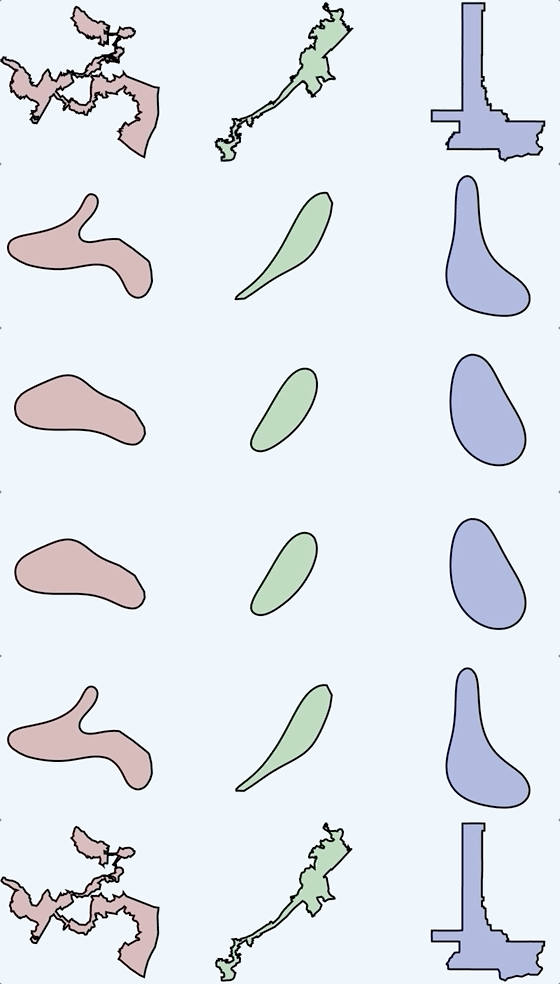
Measuring compactness – is fair districting all about shapes? How do you quantify if a district “has a weird shape”? Does banning weird shapes actually prevent gerrymandering? Read more in this explainer by Moon Duchin from the book “Political Geometry.”
-

-
Can we build metrics of electoral fairness? While most people agree that things like proportionality and competitiveness are important democratic ideals, we rarely agree on how to measure these things.
Here are some resources on building metrics of electoral fairness.
- Chapter 2 of Political Geometry by Mira Bernstein and Olivia Walch explores different ways to measure how fair maps are with respect to parties.
- Chapter 3 by Moon Duchin and Olivia Walch discusses how fairness is (or isn’t) baked into the design of U.S. democracy by interviewing four political thinkers.
-
-
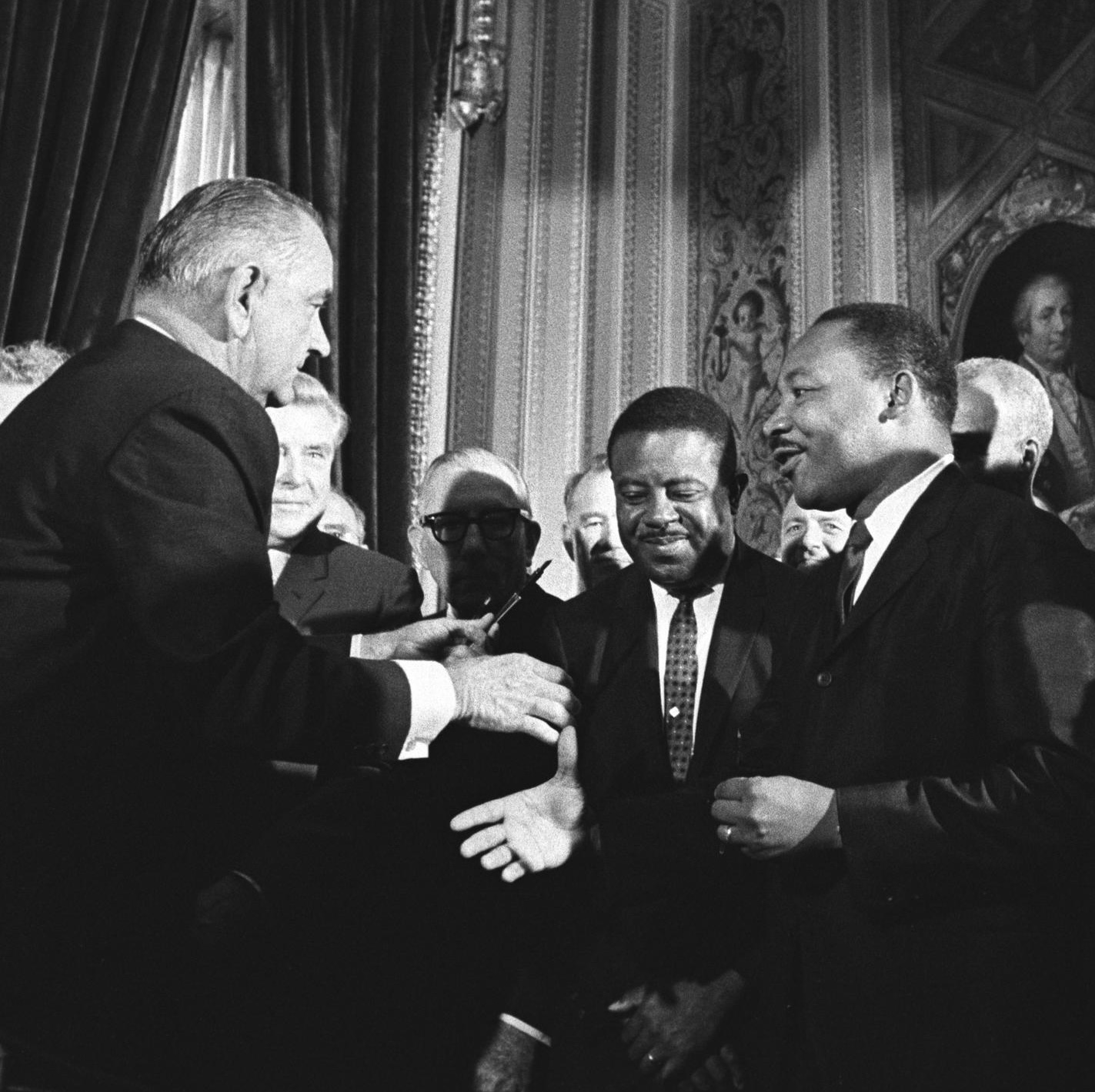
The Voting Rights Act and minority representation: Widely considered to be one of the most crucial pieces of legislation passed during the civil rights era, the 1965 Voting Rights Act (VRA) was passed in order to eliminate racial discrimination in voting.
- Learn more about the key provisions of the VRA here in Chapter 6 of “Political Geometry” by Arusha Gordon and Douglas M. Spencer.
- What does the legal landscape around race and redistricting look like? Find out here in Chapter 7 by Ellen D. Katz.
- Read about how parties and race play into polarized voting in Chapter 22 by Arusha Gordon.
-
-
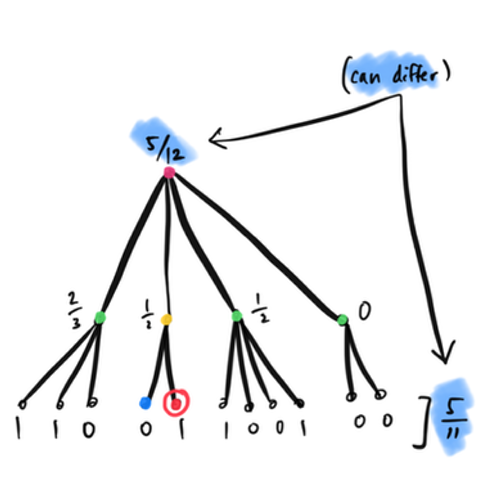
Privacy and the census: In order to protect the privacy of individual Census respondents, Census data is released only at aggregate levels, typically combining records for hundreds of individuals or more and just reporting the overall counts. Unfortunately, on its own, this does not provide enough protection to prevent privacy attacks.
To handle this privacy threat, the 2020 Decennial Census was released with a new disclosure avoidance system in place.
- Click through a presentation compiled for the Arizona Redistricting Commission on how privacy and the census interact.
-
-
Common data sources: The Lab uses a wide variety of data products to study electoral systems. Some of the most common include Census data and the American Community Survey, as well as electoral results on voting precincts.
- Read up on the basics of Census and redistricting data in Chapter 13 of “Political Geometry” by Lee Hachadoorian and Ruth Buck.